Campaign Optimisation: The Autonomous Engine
The latest MarTech platforms analyse behavioural patterns and segment audiences based on real-time interactions, enabling dynamic retargeting and personalised messaging.


Imagine having an expert strategist reviewing every campaign before it launches, that's exactly what AI-powered optimisation delivers. The latest MarTech platforms analyse behavioural patterns and segment audiences based on real-time interactions, enabling dynamic retargeting and personalised messaging.
These aren't generic tips. The AI understands your industry, learns from your past campaigns, and compares your approach against millions of successful campaigns across their platform. It might suggest adjusting your send time to match when your specific audience is most active, or recommend tweaking your call-to-action based on what's proven effective for similar segments.
If segmentation is the "brain" determining who to target, campaign optimisation is the "muscle" executing the strategy. The industry is rapidly transitioning from automated campaigns (rule-based execution) to autonomous campaigns (goal-seeking AI). Platforms like Google, Meta, and Albert.ai are pioneering "black box" optimisation where the marketer defines the objective (e.g., ROAS of 4.0), and the machine learning engine handles the targeting, bidding, creative selection, and placement. This shift requires marketers to relinquish control over granular inputs in exchange for superior algorithmic performance.
1. The Rise of Algorithmic Media Buying
The manual levers of digital advertising, keyword bid adjustments, placement exclusions, hour-of-day modifiers, are being deprecated in favour of algorithmic controls that process signals at a scale and speed impossible for humans.
1.1 Google Performance Max (PMax)
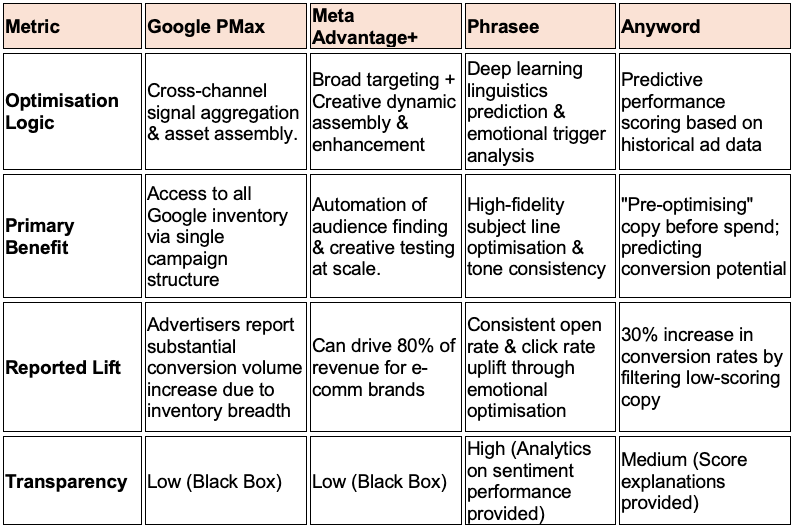
Performance Max represents the apex of Google’s automation strategy. It is a goal-based campaign type that allows advertisers to access all of Google's inventory (YouTube, Display, Search, Discover, Gmail, and Maps) from a single campaign structure.
- Mechanics of Automation: PMax uses complex machine learning to analyse audience signals in real-time. Unlike search campaigns that rely on explicit keyword intent, PMax infers intent from a broad array of signals including browsing history, location context, previous interactions, and cross-device behaviour. It optimises for the "conversion value" rather than just clicks, dynamically adjusting bids for every single auction.
- Asset Groups vs. Ads: Marketers no longer create "ads" in the traditional sense; they provide "asset groups" consisting of images, headlines, logos, and videos. The system continuously tests thousands of combinations of these assets to find the highest-performing variant for each specific user context.
- Keyword Cannibalisation & Prioritisation: An interesting nuance in the PMax logic is its relationship with traditional search. PMax respects exact match keywords in Search campaigns but will effectively "cannibalise" broad or phrase match traffic if it determines it has a higher probability of conversion, effectively overruling manual campaign structures in favour of its own algorithmic predictions. This necessitates a strategic restructuring of ad accounts to prevent internal competition.
1.2 Meta Advantage+ Shopping Campaigns
Parallel to Google, Meta has consolidated its machine learning capabilities into the Advantage+ suite, specifically the Advantage+ Shopping Campaigns (ASC). This infrastructure automates the full funnel of ad delivery, from audience discovery to creative presentation.
- Elimination of Manual Targeting: In Advantage+ Shopping Campaigns, marketers are encouraged not to select audiences. The algorithm uses the pixel data and conversion history to find the audience broadly. It treats targeting as a fluid variable rather than a constraint, allowing the system to find buyers outside of the marketer's preconceived demographic definitions.
- Creative Fluidity: The system dynamically adjusts creative formats, transforming static images into videos or reordering carousel cards based on individual user preferences. It also employs "Standard Enhancements" which can automatically adjust brightness, contrast, or even add artistic filters if the AI predicts a higher click-through rate.
- Efficiency Benchmarks: Early adopters report that Advantage+ can drive up to 80% of revenue for e-commerce brands by reaching audiences that manual targeting would typically exclude. However, this comes at the cost of transparency; the "black box" nature means marketers often cannot explain why a campaign worked, only that it did, leading to a reliance on the platform's internal reporting.
1.3 Albert.ai: The Fully Autonomous Marketer
Taking automation a step further, Albert.ai positions itself as an autonomous artificial intelligence that sits above platforms like Google and Meta. While PMax optimises within Google, Albert optimises across channels.
- Cross-Channel Budget Fluidity: Albert can autonomously shift budget from a Facebook campaign to a Google Search campaign in real-time if it detects a higher marginal ROAS, a task that typically requires manual intervention and cross-platform analysis.
- Long-Tail Discovery: Albert specialises in finding "long-tail" search opportunities and micro-segments that human buyers typically ignore due to the sheer volume of data processing required. It executes thousands of keyword permutations and bid adjustments daily, operating 24/7 to capture ephemeral opportunities.
2. Generative Copy and Creative Optimisation
Optimisation is no longer limited to distribution; it now extends to the creation of the content itself. Tools like Jacquard, Anyword, Jasper, and HubSpot Content Remix utilise LLMs not just to write copy, but to predict its performance before it ever goes live.
2.1 Predictive Performance Scores with Anyword
Anyword differentiates itself by offering a "Predictive Performance Score" for generated copy. Trained on billions of data points of ad performance, Anyword analyses a drafted headline or social post and assigns a score (0-100) predicting its conversion potential.
Pre-Live Optimisation: This allows marketers to "A/B test" copy against the AI model before spending budget on live traffic. Users can click a "Boost Performance" button, and the AI will rewrite the copy specifically to improve the predicted score, optimising for specific demographics or platforms (e.g., rewriting a LinkedIn post to be more professional or an Instagram caption to be more engaging). This "Performance Boost" workflow acts as a virtual editor, iterating on copy until it meets a statistical threshold for success.
2.2 Jacquard: Deep Learning for Brand Language
Jacquard (formerly Phrasee) focuses on the scientific optimisation of language, particularly for email subject lines and push notifications. Unlike generic generative tools, Jacquard builds a unique language model for each brand, ensuring tone consistency.
Natural Language Generation (NLG) & Deep Learning: Jacquard generates thousands of variants and uses deep learning to predict which specific emotional triggers (e.g., "Curiosity" vs. "Urgency" vs. "Friendliness") will resonate with a specific audience segment. This moves copy optimisation from a creative art to a data-driven science. By treating every send as a massive multivariate test, Jacquard's deep learning model continuously refines its understanding of what drives engagement for that specific brand's audience.
2.3 Jasper and HubSpot: Asset Transformation and Agents
Jasper has evolved from a simple writing tool to a platform of "AI Marketing Agents" that understand brand voice and style guides.
Browser Extensions: Jasper’s browser extension brings this intelligence directly into platforms like Gmail, LinkedIn, and WordPress/Webflow. This allows marketers to use AI to draft sales emails or social posts directly within the native interface of those platforms, ensuring that the AI assistance is available exactly where the work happens.
HubSpot Content Remix: This feature addresses the challenge of content scale. It allows a marketer to take a single high-performing asset, such as a blog post, and "remix" it into multiple formats, a landing page, an email sequence, and social media posts, in seconds. The AI understands the context of the original asset and adapts the message for the constraints of the new format (e.g., shortening text for Instagram, adding CTAs for a landing page). This repurposing capability exponentially increases the mileage of core content assets.
AI enables brands to adapt offers, creatives, and recommendations in real time, matching each customer's unique preferences and behaviours. Algorithms can now automatically adjust bids, recalibrate ad spend, and shift placements in real time to optimise efforts for each customer.
Other tools worth a look:
Google AI Max for Search: Text customisation helps generate new text assets like headlines and descriptions based on landing pages, ads, and keywords. Features include final URL expansion to send users to the most relevant pages on websites.
Meta's Value Optimisation: Enhanced AI optimisation for app advertisers delivers 29% higher return on ad spend compared to campaigns optimising for conversion volume, representing a substantial increase from the 12% improvement documented earlier in 2025.
Adobe Target: Offers multivariate testing, automated personalisation, AI-powered Auto-Targeting, and recommendations, leveraging Adobe Sensei to dynamically tailor experiences to individual users.
Recap: The Rise of the Autonomous Engine
In this article, we explored how Campaign Optimisation has evolved from a manual grind to an autonomous science. We looked at how "black box" algorithms like Google Performance Max and Meta Advantage+ are now managing the heavy lifting of targeting and bidding, effectively turning the marketer from a pilot into a flight director. We also saw that creative work is getting a data-driven upgrade, tools like Anyword and Jacquard aren't just generating copy, they are predicting its performance score before you spend a dime.
The takeaway? Efficiency isn't about working faster; it's about letting the machine do the work so you can focus on the strategy.
But as your campaigns run autonomously across search, social, and email, they generate mountains of disconnected data. How do you see the full picture without opening fifty tabs?
In Your Next Marketing Bytes Newsletter: Cross-Platform Analytics & Generative BI
In the next instalment, we tackle Cross-Platform Analytics. We’ll move beyond static spreadsheets and introduce you to the world of Generative BI, dashboards that don’t just display charts, but use AI to explain them in plain English. We will explore how tools like Databox and AgencyAnalytics are breaking down data silos to provide a unified "source of truth" for your marketing ROI.
Subscribe below to receive Part 3 in your inbox