Your Favourite Marketing Platforms Just Got Smarter


In the last 12 months, AI transformed how marketing teams work with powerful features designed to save hours each week whilst dramatically improving campaign performance. These intelligent features adapt to how you actually work, helping you focus on what truly matters: delivering results that move the needle.
The Evolution of Intelligent Marketing Infrastructure
The technological infrastructure of modern marketing has undergone a fundamental metamorphosis, shifting from systems of record to systems of intelligence. A 2025 research by McKinsey revealed that 79% of CMOs viewed AI as an essential tool for competitive advantage.
For the past decade, the primary value proposition of the marketing technology (MarTech) stack was defined by efficiency through automation, the ability to schedule emails, trigger linear workflows based on static logic, and consolidate data repositories for historical reporting.
However, as we review the landscape of 2025, a new paradigm has crystallised. Marketing platforms are no longer passive repositories of customer data or simple execution engines, they developed into active cognitive partners capable of predictive foresight, autonomous decision-making, and generative creativity.
This newly launched blog provides an exhaustive, expert-level analysis of this transformation, exploring how "smart" features are redefining the core pillars of the marketing function: segmentation, campaign optimisation, analytics, experimentation, and real-time collaboration.
The integration of artificial intelligence (AI), specifically large language models (LLMs) and advanced machine learning (ML) algorithms, has birthed a new class of features that do not merely execute commands but anticipate strategic needs. We are witnessing the rise of "Agentic AI", software agents embedded within foundational platforms like HubSpot and Salesforce that can autonomously plan and execute complex tasks across the customer lifecycle.
Simultaneously, the rigorous statistical methodologies of experimentation are being revolutionised by Bayesian engines and multi-armed bandit algorithms that optimise traffic routing in real-time, effectively rendering the static "A/B test" a relic of a slower era.
This evolution is transformative. It changes the role of the marketer from a "driver" of software, pulling levers and setting rules, to an "architect" of outcomes, defining goals and guardrails while the cognitive layer manages the execution.
This 5 part report dissects these advancements across five critical dimensions of marketing technologies:
- Smart Segmentation (further down): The transition from static lists and Boolean logic to predictive behavioural modelling and natural language query generation.
- Campaign Optimisation: The shift from manual bidding and creative assembly to autonomous, algorithmic media buying and performance-aware generative copy.
- Cross-Platform Analytics: How AI is Automating Data Interpretation: Are you drowning in data but starving for insights? We explore the new wave of Generative BI tools that don't just show you the numbers, they tell you what they mean. Learn how OpenAI-powered dashboards are ending the 'swivel-chair' struggle.
- Real-Time Collaboration: The Agile Marketing Workbench: Is your team stuck in 'version control hell'? We explore how tools like Figma and Monday.com are killing the email chain and letting marketers ship campaigns in record time.
- A/B Testing on Steroids: How AI Predicts Winners Before You Do: A break down of the shift from Frequentist to Bayesian logic and why tools like Unbounce are changing the game.
By analysing the marketing technology capabilities of market leaders such as Klaviyo, Google, Meta, VWO, Unbounce, Databox, Figma, and ClickUp, this report establishes a rigorous benchmark for what enterprise marketing teams should expect from their technology stack. The era of the "smart" platform has arrived, and it demands a fundamental re-evaluation of how marketing strategy is technically implemented.
This article focuses on the first part: "Smart Segmentation", subscribe to the newsletter to be the first to read the next edition, which will focus on part 2: "Campaign Optimisation: The Autonomous Engine".
Let's look first at "Smart Segmentation"
The traditional approach to audience segmentation, such as relying on static demographic data or basic Boolean logic (e.g., "User is in Location X" AND "Clicked Link Y"), is rapidly becoming obsolete. In its place, a sophisticated methodology of predictive behavioural segmentation has emerged.
This new standard utilises historical data not merely to categorise past actions but to forecast future behaviours, enabling marketers to target users based on probabilistic future states rather than retrospective interaction logs. This shift represents a fundamental move from reactive targeting to proactive engagement.
Modern marketing platforms are increasingly functioning as Customer Data Platforms (CDPs) with embedded intelligence layers. The core innovation here is the democratisation of advanced data science. Previously, calculating metrics such as Customer Lifetime Value (CLV), churn risk, or propensity to buy required dedicated data science teams and complex SQL queries.
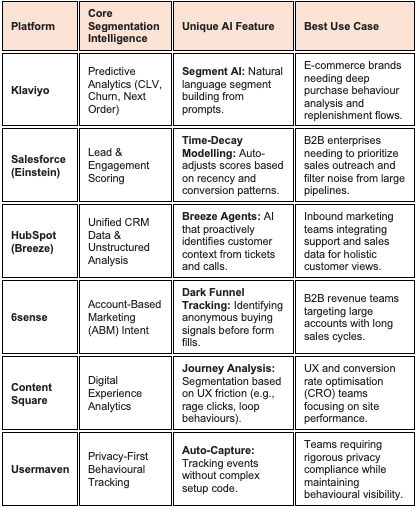
Today, platforms like Klaviyo and Salesforce Marketing Cloud generate these insights automatically, embedding them directly into the segmentation logic available to the non-technical marketer.
Forget manually creating audience segments based on guesswork. Artificial Intelligence significantly enhances behavioural segmentation by analysing vast amounts of user data across multiple channels, rapidly identifying patterns in shopping habits, website visits, and media consumption using machine learning algorithms.
1. The Mechanics of Predictive Analytics in Customer Data Platforms (CDPs)
Klaviyo’s Predictive Suite: CLV and Churn Risk
Klaviyo has pioneered the integration of predictive analytics into the daily workflow of e-commerce marketers, fundamentally altering how retention strategies are deployed. Their architecture allows for the creation of segments based on probabilistic outcomes derived from machine learning models trained on vast datasets of consumer transaction behaviours, automatically grouping customers based on browsing habits, purchase history, and predicted lifetime value, with integrations into platforms like Shopify and WooCommerce.
The underlying mechanics involve analysing the Recency, Frequency, and Monetary (RFM) value of customer interactions but enhancing this with machine learning models that detect subtle, non-linear patterns in purchase intervals.
- Predicted Next Order Date: By analysing the average time between purchases for specific cohorts and adjusting for individual variance, the platform predicts the specific date a customer is likely to purchase again. This capability allows for the creation of "replenishment" flows that trigger exactly when the customer is ready to buy, rather than on a generic, static schedule. This moves the communication from a nuisance to a service.
- Spending Potential and Lifetime Value: The system estimates the total monetary value a customer represents over their remaining relationship with the brand. This allows brands to employ differential discounting strategies, suppressing margin-eroding discounts for high-value loyalists who are likely to convert regardless, while aggressively incentivising low-value, high-churn risks.
- Churn Risk Modelling: By identifying deviations from established engagement patterns, such as a user who typically opens every email suddenly going dormant, Klaviyo’s AI assigns a churn probability score. Marketers can then create automated "win-back" segments that activate only when a user crosses a specific risk threshold.
This "marketer-enabled" data science removes the friction of technical implementation. The AI identifies distinct, behaviourally complex groups, such as "VIPs," "At-Risk," or "One-Time Buyers", and updates these segments in real-time as user behaviour changes.
The implications for ROAS (Return on Ad Spend) are profound; by syncing these predictive segments to ad platforms like Meta and Google, brands can create lookalike audiences based on future value rather than just past purchases, significantly improving acquisition efficiency.
Salesforce Einstein: Engagement Scoring and Lead Prioritisation
In the B2B and enterprise space, Salesforce’s Einstein Engagement Scoring represents the pinnacle of behavioural analysis applied to long sales cycles. Unlike traditional lead scoring, which assigns static point values to actions (e.g., +5 points for a webinar signup, +10 for a white paper download), Einstein uses predictive modelling to assess the likelihood of conversion based on the sequence and context of interactions.
- Behavioural Scoring vs. Static Scoring: Traditional Pardot scores accumulate indefinitely, often resulting in skewed data where long-time "window shoppers" appear as "hot leads" simply because they have accumulated points over years of passive newsletter consumption. Einstein Behaviour Scoring solves this by using time-decay models and cohort comparison. It compares a prospect's recent activity against the specific patterns of successful conversions, identifying meaningful engagement sequences rather than just volume of activity.
- Decay and Contextual Retraining: The model is not static, it retrains itself every 10 days, ensuring that the definition of a "good lead" evolves with market trends and business shifts. If a prospect stops engaging, their score decays automatically, keeping sales teams focused strictly on active opportunities. This dynamic scoring prevents the sales pipeline from becoming clogged with stale leads that mask true opportunities.
- Likelihood to Convert: Einstein distinguishes between mere activity and intent. It analyses the types of content consumed—differentiating between a user reading a blog post about industry trends (low intent) versus visiting a pricing page or technical documentation (high intent), to provide a nuanced "Likelihood to Convert" score that guides sales prioritisation.
2. Agentic Segmentation: Natural Language and the Rise of AI Agents
A significant leap forward in 2025 is the introduction of AI Agents and natural language interfaces that fundamentally change the user experience of segmentation. This capability, exemplified by HubSpot’s Breeze Intelligence and Klaviyo’s Segment AI, democratises access to complex data querying.
Marketers no longer need to understand complex database schemas, Boolean operators, or SQL logic to build sophisticated audiences. Instead, they can input a prompt such as: "Create a segment of customers who opened a support ticket in the last week, spent more than $500 lifetime, and haven't purchased in 3 months". The AI agent parses this natural language, maps it to the underlying data fields (e.g., Zendesk integration data, Shopify transaction history, email activity), and constructs the precise logic required.
HubSpot’s Breeze Agents go further by proactively surfacing insights from unstructured data. The Prospecting Agent and Customer Agent can analyse unstructured text, such as email content, call transcripts, and support tickets, to identify behavioural signals that structured data might miss.
- Contextual Understanding: An agent might identify a segment of users who expressed frustration with a specific feature in support tickets. A traditional filter might miss this sentiment, but the AI agent can tag these users and automatically exclude them from upsell campaigns for that specific feature, preventing tone-deaf marketing that could exacerbate churn.
- Knowledge Base Integration: The new Breeze Knowledge Base Agent can analyse support tickets to identify gaps in documentation, but it also serves a marketing function by identifying common user questions that can be transformed into high-value content marketing assets, closing the loop between service and acquisition.
3. Behavioural Segmentation Benchmarks and Tool Landscape
The shift to smart segmentation is driven by tangible economic necessity. Benchmarks indicate that privacy-first, first-party data strategies are becoming the only viable path forward as third-party cookies vanish.
- Efficiency Gains: Tools like Usermaven and ContentSquare focus on identifying friction points in the user journey through behavioural cohorts, allowing for segmentation based on experience (e.g., "Rage Clickers" or "Hesitant Buyers"). ContentSquare specialises in analysing the user journey to pinpoint where users struggle, allowing marketers to create segments of users who experienced specific errors or UI friction for targeted recovery campaigns.
- Social Intelligence: Audiense brings psychographic segmentation to the forefront, specialising in social media audience intelligence. It segments users not just by what they buy, but by who they influence and what content they consume, allowing for highly targeted influencer strategies.
- Cohort Analysis: Amplitude excels in behavioural cohorting, allowing product-led growth (PLG) companies to segment users based on feature adoption curves. This is critical for SaaS marketing, where the goal is often to drive users from "freemium" to "paid" based on their usage patterns.
Conclusion: The Shift from Reactive to Predictive
The era of static demographic lists is officially over. As we’ve explored, Smart Segmentation isn't just about grouping customers by who they were, it’s about targeting them based on who they are likely to become. By leveraging predictive modelling to forecast Lifetime Value (CLV) and churn risk, and utilising AI agents to build complex audiences through natural language, you transform your customer data from a passive record into a proactive growth engine.
But knowing who to target is only half the battle. Once you have your ideal audience, how do you ensure your creative reaches them at the exact right moment, without spending hours on manual bid adjustments?
In Your Next Marketing Bytes Newsletter we will dive into Campaign Optimisation: The Autonomous Engine. We’ll uncover how autonomous AI agents are replacing manual A/B testing and media buying to maximise your ROAS while you sleep.
Subscribe below to ensure it lands directly in your inbox.